MegaGlobal Kereskedelmi és Szolgáltató Kft.

Identification technology backed by standards, systems, and experience

Clear identification is the basis of modern industrial and logistics operations. At Megaglobal, we approach identification technology not at the device level, but at the system level: based on standards, environment, and real-world use.

The origin of the barcode: where did identification begin?

The roots of barcode technology date back to the 1940s.
The first machine-readable codes were developed for the food trade and logistics, where fast, unambiguous and automatable identification was required.

  • The first commercial barcode was scanned in 1974.
  • Its purpose was to replace manual data entry.
  • Its basic principle: visual signal → machine interpretation → data.

Since then, barcodes have become one of the most reliable and widespread forms of identification in industry.

Interesting fact: labeling is not a modern invention!

Identification and marking were present in human culture long before modern technology. Shepherd's marks, runic symbols, property marks, and the repetitive stripe patterns of folk weaving all served the same purpose: to clearly distinguish and identify.


Barcode structure and operation

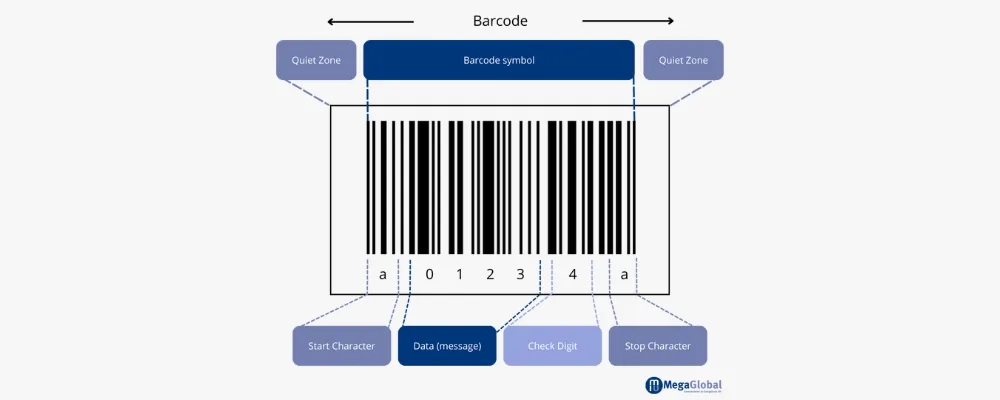
A barcode is not “just a bunch of stripes.” It is a strictly defined structure that is interpreted by a scanning device.

The main elements of a barcode are:

  • Start and stop sequences
  • Data field(s)
  • Check digit
  • Quiet zone
Difference between 1D and 2D codes
1D

Linear

Less data, faster reading.
(E.g.: EAN-13, Code 128)
2D

Matrix-based

More data, smaller size, greater error correction.
(E.g.: DataMatrix, QR)

Selecting the appropriate code type is process-dependent, not device-dependent.

Barcode and RFID technologies

Aspect Barcode RFID
Operation Optical, visual identification Radio-frequency, contactless identification
Cost Cost-effective Higher initial investment cost
Reliability Proven, stable technology Highly efficient in high-volume environments
Industry coverage Usable in almost every industry Logistics, manufacturing, asset tracking
Reading method One by one, with line of sight Multiple items at once, without line of sight
Verifiability Visually verifiable Non-visual identification
Typical use Product identification, warehousing, retail High-volume movements, automation

At Megaglobal, we don’t force technology on you, but select the right one for your environment — or even combine them.

Barcode or RFID?

In many cases, the most effective solution is not the answer to the question "barcode or RFID," but rather the combined use of both technologies.

IP protection: protection against dust and water

Environmental impact is a key factor when selecting industrial equipment.
This is determined by the IP (Ingress Protection) rating.

IP code Dust protection Water protection Typical environment
IP20 None None Office
IP54 Limited Splash Warehouse
IP65 Full Water jet Industrial
IP67 Complete Submersible Outdoor
IP68 Complete Durable Water Extreme

Why is IP protection important?

Poorly chosen IP level = malfunction + failure.

GS1: the system behind the global standard

GS1 is an international standards organization that ensures that identifiers are consistent worldwide.

Main functions of GS1:

  • GTIN (product identification)
  • GLN (location identification)
  • SSCC (logistics units)
  • Standard data content in 1D and 2D codes

Without GS1 standards, the global supply chain could not be automated.

Technology + experience

Technology alone is not enough. At Megaglobal, standards, tools, and industry experience combine to provide a working solution.

Let's discuss which technology best suits your processes!